—A Discussion on the Historical Naming of the 1989 Military Crackdown in Beijing
Fei Liangyong
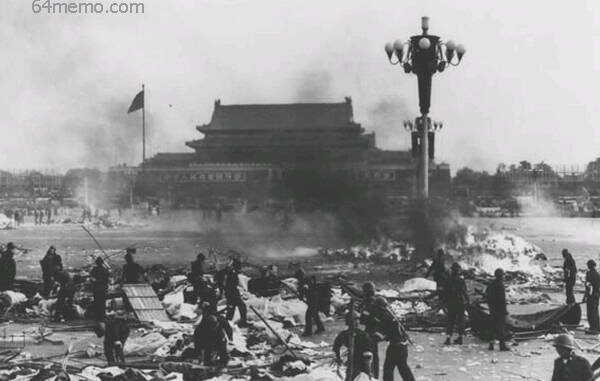
One basic fact is beyond dispute: on the night of June 3 and into June 4, 1989, the Chinese government deployed martial-law troops of the People’s Liberation Army, using tanks, armored vehicles, and troops armed with automatic weapons to force their way into urban Beijing. They used live ammunition against crowds that included large numbers of unarmed students, Beijing residents, and other civilians, causing large numbers of deaths and injuries. Many of the most serious casualties occurred along the routes taken by martial-law troops as they advanced toward central Beijing and in the areas surrounding Tiananmen Square. The Beijing June Fourth Massacre therefore cannot simply be equated with “the massacre of students inside Tiananmen Square.”
Amnesty International’s 1989 investigation reported that, on the night of June 3 and into June 4, troops used live ammunition as they advanced from western Beijing toward the city center. The majority of civilian casualties in Beijing appear to have occurred along Chang’an Avenue, the east–west thoroughfare leading toward Tiananmen Square. The investigation also documented killings at Muxidi and other locations. It explicitly recorded troops opening fire on crowds and deaths caused by armored vehicles, and described the events as the “killings of unarmed civilians.”
The Death Toll
The exact death toll of the Beijing June Fourth Massacre has never been established through an independent investigation. The Chinese government has long restricted investigation, discussion, and commemoration of June Fourth, and it has never published a complete list of the victims that has been independently verified.
Amnesty International currently states that hundreds, possibly thousands, were killed. The Chinese government, by contrast, announced in late June 1989 that more than 200 civilians had died, including 36 university students. Amnesty International considers the official death toll likely to be a gross underestimate.
It is worth noting that, in its preliminary investigation published in August 1989, Amnesty International estimated that at least 1,000 civilians were killed and several thousand injured in Beijing between June 3 and June 9. At the same time, it explicitly stated that the climate of fear and continuing persecution following the crackdown made it impossible to determine the true number of deaths.
Radio Free Asia (RFA) reported on June 3, 2015, that a map published by the Tiananmen Mothers in 2009 listed more than 250 names, based on corroborated eyewitness testimony and hospital records. An RFA report in 2025 also noted that the Tiananmen Mothers had published a detailed map of locations where people were killed in 2009, and again emphasized that the Chinese government has never disclosed the actual numbers of people killed and injured.
On a Radio Free Asia (RFA) blog, I found a “List of June Fourth Victims” compiled from information made public by the Tiananmen Mothers. The list contains 202 victims. It preserves information about the victims’ names, identities, and circumstances of death and, in the context of the authorities’ longstanding restrictions on independent investigation and public discussion, constitutes an important body of unofficial historical documentation.
Most of the victims on this list are identified by their full names. However, 14 remain completely unidentified, while nine are identified only by surname, without a given name. This in itself demonstrates that even among the victims already documented through independent civilian efforts, there are still people whose full identities have never been established. The great majority of those on the list are recorded as having died from gunshot wounds, but victims Nos. 0019, 0020, and 0054 are recorded as having been crushed to death by tanks. Since the authorities have never permitted a comprehensive and independent investigation, such lists clearly cannot be regarded as complete lists of all those who died.
Whatever the final confirmed death toll of the Beijing June Fourth Massacre may ultimately prove to be, one fundamental historical fact is not altered by the fact that the total number of deaths remains unknown: the Chinese government deployed martial-law troops of the People’s Liberation Army and used tanks, armored vehicles, and automatic weapons to carry out a violent crackdown against students, Beijing residents, and other civilians, causing large numbers of deaths and injuries. Existing records of the victims document numerous deaths from gunfire; moreover, in the above-mentioned list of 202 victims alone, three individuals are explicitly recorded as having been crushed to death by tanks.
On the Tiananmen Massacre
Following the massacre in Beijing on June 4, 1989, “Tiananmen Massacre” gradually became one of the best-known English terms for the crackdown in international media and human rights discourse.
There are several reasons why this term came into use. First, “Tiananmen” was the center and symbol of the 1989 democracy movement in Beijing and throughout China. Second, Tiananmen Square was the movement’s central political space and the principal location that the martial-law troops ultimately sought to clear and bring under their control. Third, because the Chinese Communist Party authorities imposed a strict information blockade, and because there was no open and independent investigation into either the final clearing of Tiananmen Square or the casualties at different locations across Beijing, it was difficult for the international community in the immediate aftermath to establish precisely how many people had been killed at particular locations. Fourth, although large numbers of students withdrew from the Square before the final clearing operation, Amnesty International’s detailed investigation recorded that when a column of students who had left the Square reached Liubukou, armored vehicles drove into the crowd, killing 11 people. Fifth, early eyewitness accounts differed as to exactly how much killing took place inside Tiananmen Square itself.
After the event, Chinese authorities repeatedly denied that anyone had been killed during the clearing of Tiananmen Square. However, according to the Tiananmen Mothers’ Civilian Report on the Victims of the June Fourth Crackdown, at least three students were confirmed to have been shot and killed in Tiananmen Square: Cheng Renxing, who was pursuing two bachelor’s degrees at Renmin University of China; Dai Jinping, a master’s student at Beijing Agricultural University; and Li Haocheng, an undergraduate at Tianjin Normal University.
In retrospect, there is still good reason to use “the Tiananmen Massacre” as a symbolic name for the crackdown on the entire 1989 democracy movement. The term does not necessarily imply that all, or even most, of those killed died inside Tiananmen Square. Amnesty International now also uses the term 1989 Tiananmen Crackdown and states that troops opened fire on students, workers, and others “in and around Tiananmen Square.”
On the other hand, if “the Tiananmen Massacre” is interpreted literally and narrowly to mean “a massacre that took place inside Tiananmen Square,” the term can create a misleading impression about the geographical location of the killings.
“The Beijing June Fourth Massacre” Is a More Accurate Historical Term
Existing evidence indicates that a large number—and apparently the majority—of civilian casualties occurred along the routes taken by troops as they advanced toward central Beijing, particularly along Chang’an Avenue and in areas such as Muxidi. The Beijing June Fourth Massacre therefore should not be understood as a massacre that took place primarily inside Tiananmen Square. The students withdrew from the Square before the final clearing operation. Accordingly, a more accurate name for the massacre is the “Beijing June Fourth Massacre.” I believe this is the most accurate Chinese name for the historical event. It clearly identifies three essential elements—Beijing, June Fourth, and mass killing—while avoiding the geographical misconception that the massacre took place primarily inside Tiananmen Square.
The naming of historical events should, as far as possible, distinguish between the “symbolic center” of an event and the “principal sites of killing.” Tiananmen Square was unquestionably the most important symbolic center of the 1989 democracy movement and the central political space that the martial-law troops ultimately brought under their control. However, the symbolic center of a movement is not necessarily the principal location where large-scale killing occurred. For precisely this reason, “the Tiananmen Massacre” carries a symbolic meaning established through decades of historical usage, whereas “the Beijing June Fourth Massacre” provides a more precise indication of both the time and the geographical scope of the event.
The English translation of “北京六四大屠杀” is “The Beijing June Fourth Massacre.” When the term first appears in an English-language text, it may be written as: “The Beijing June Fourth Massacre of 1989 (commonly known internationally as the Tiananmen Massacre).” This immediately enables international readers to identify the historical event being discussed while also helping them understand the rationale for the proposed terminology.
The German translation of “北京六四大屠杀” is “Das Massaker vom 4. Juni in Peking.” However, for greater clarity to German readers, “Das Massaker vom 4. Juni 1989 in Peking” is preferable, since it clearly specifies both the date and the location.
In addition, “the June Fourth Massacre” is the most concise formulation. In a Chinese context, its meaning is clear: it refers specifically to the massacre associated with June 4, 1989, and is particularly suitable for titles, slogans, and commemorative events. Its disadvantage is that it does not explicitly identify the location of the massacre. Chinese readers may readily associate “June Fourth” with Beijing, whereas readers in other linguistic contexts may find the reference less immediately understandable.
The term “the Beijing Massacre” may also be used, but it is somewhat less readily identifiable when removed from its historical context because it does not specify a date.
In formal writing, the full term “the Beijing June Fourth Massacre” should preferably be used when the event is first mentioned, followed, if desired, by a parenthetical indication of the shortened form to be used thereafter, such as “hereinafter, the Beijing Massacre” or “hereinafter, the June Fourth Massacre.” This makes the historical meaning clearer.
Historical naming is not merely a matter of words. Names shape how people remember history and may also influence how future generations understand it. “The Tiananmen Massacre” has become an important symbolic term through which the international community understands the June Fourth crackdown, and the historical significance acquired by that term through widespread usage should be respected. However, when seeking to describe more precisely the large-scale killings that took place in Beijing on June 3–4, 1989, I advocate the use of “the Beijing June Fourth Massacre.” This name preserves “June Fourth,” a temporal symbol deeply embedded in Chinese historical memory, while explicitly identifying Beijing as the location of the massacre without geographically restricting the killings to Tiananmen Square itself. Accurately naming the history of what happened to the victims is itself part of preserving historical truth.
Written in Nuremberg on August 18, 2026
******************** **************************** ******************************
Key Historical Sources and References
Historical Note: This article’s advocacy of the term “the Beijing June Fourth Massacre” does not imply that the massacre occurred only on June 4. In Chinese historical memory, “June Fourth” has become a historical shorthand for the crackdown that began on the night of June 3 and continued into June 4, 1989, as well as the repressive actions that followed. Existing evidence confirms that large numbers of civilian deaths and injuries occurred along the routes taken by martial-law troops as they advanced into central Beijing and in the areas surrounding Tiananmen Square. Tiananmen Square itself was the most important symbolic center of the democracy movement and the central site of the military clearing operation. Therefore, “the Beijing June Fourth Massacre” is intended as a historical designation for the military crackdown and large-scale killings in Beijing as a whole, rather than as a description confined to a single location or a single moment in time.
- Amnesty International, People’s Republic of China: Preliminary Findings on Killings of Unarmed Civilians, Arbitrary Arrests and Summary Executions since 3 June 1989, 30 August 1989.
This is one of the most important early human rights investigations used in this article. Drawing on eyewitness accounts, hospital information, and other sources in its investigation of the crackdown in Beijing, Amnesty International estimated that at least 1,000 civilians were killed and several thousand injured between June 3 and June 9. At the same time, it emphasized that the climate of fear following the crackdown made it impossible to determine the true death toll.
- Amnesty International, follow-up investigation into the 1989 Beijing crackdown, 1990.
This more detailed report is particularly important because it documents an incident at Liubukou in which a column of students who had withdrawn from Tiananmen Square was struck by armored vehicles, resulting in 11 deaths. It directly supports this article’s argument that students had already withdrawn from the Square but were subsequently subjected to further military violence.
- Amnesty International, “The 1989 Tiananmen Crackdown.”
This is Amnesty International’s current overview of the events. It states that on June 4, 1989, troops opened fire on students, workers, and others calling for political reform in and around Tiananmen Square in Beijing, killing hundreds—and possibly thousands. It also cites the Chinese government’s official figures of more than 200 civilian deaths, including 36 university students, while noting that the official death toll is likely to be a gross underestimate.
- Amnesty International, “China: ‘Heartless’ ban on Tiananmen Mothers visiting cemetery signals escalating repression,” 3 June 2026.
This recent Amnesty International statement continues to describe how, on June 4, 1989, Chinese troops opened fire on students and workers in and around Tiananmen Square, killing hundreds and possibly thousands.
- Tiananmen Mothers, Civilian Report on the Victims of the June Fourth Crackdown.
This is one of the most important firsthand civilian investigations concerning deaths inside Tiananmen Square. The report records, among other cases, that Cheng Renxing was shot in the abdomen near the flagpole in Tiananmen Square and that Dai Jinping was shot and killed by martial-law troops near the Chairman Mao Memorial Hall.
- Tiananmen Mothers website: records on June Fourth victims, victims’ families, and investigative inquiries.
For decades, the Tiananmen Mothers have investigated and documented the names, identities, locations of death, and family circumstances of June Fourth victims. Their investigations into the deaths of Cheng Renxing, Dai Jinping, Li Haocheng, and others provide evidence against the categorical claim that “absolutely no one died” inside Tiananmen Square.
- Radio Free Asia, “Thousands Converge on Central Beijing Ahead of Tiananmen Anniversary,” 4 June 2015.
Radio Free Asia (RFA) reported that a 2009 map produced by the Tiananmen Mothers listed more than 250 names, based on corroborated eyewitness testimony and hospital records. The map also indicated that at least 37 people were killed in the vicinity of Muxidi.
- Radio Free Asia, 2025 reporting on the Tiananmen Mothers and the historical memory of June Fourth.
The report notes that the Chinese government has still not disclosed a complete death toll or a comprehensive list of those killed, while victims’ families continue to demand truth, accountability, and compensation.
- June 4th Memory and Human Rights Museum, biographical database.
The database systematically compiles information on people killed, injured, persecuted, or otherwise involved in the June Fourth events and related protests.
- Human Rights Watch, “China: No Justice 33 Years after Tiananmen Massacre,” 2 June 2022.
Human Rights Watch directly uses the term “Tiananmen Massacre” and calls on the Chinese government to acknowledge responsibility for the mass killings of 1989 and provide justice for the victims.
- Human Rights in China, “Unforgotten” June Fourth Memorial Project.
This project systematically preserves information about June Fourth victims and their families and supports the Tiananmen Mothers’ longstanding demands for truth, accountability, and compensation.